
Client Background
A medium-sized not-for-profit organisation based in Tasmania manages thousands of sensitive documents daily. These documents include client records, internal communications, funding reports, legal agreements, and strategic plans. The organisation operates in a compliance-driven environment, requiring strict data handling and security protocols.
Challenge
With an expanding digital footprint, the client faced mounting risks and inefficiencies:
-
Manual tagging and classification of documents were inconsistent, error-prone, and time-consuming.
-
High risk of misclassification, exposing the organisation to data leakage, privacy breaches, and non-compliance with data protection policies.
-
Lack of automation in applying protection measures (e.g., encryption, access restrictions) left sensitive documents vulnerable to unauthorised access.
The organisation sought a scalable, intelligent solution that could automatically classify and protect documents based on their content and sensitivity.
Solution by Data Gravity
Service Provided: AI-Powered Content Classification and Protection Automation
Technologies Used: Python, Microsoft Information Protection (MIP), SharePoint, Azure Cognitive Services, Power Automate
1. Intelligent Content Classification Engine
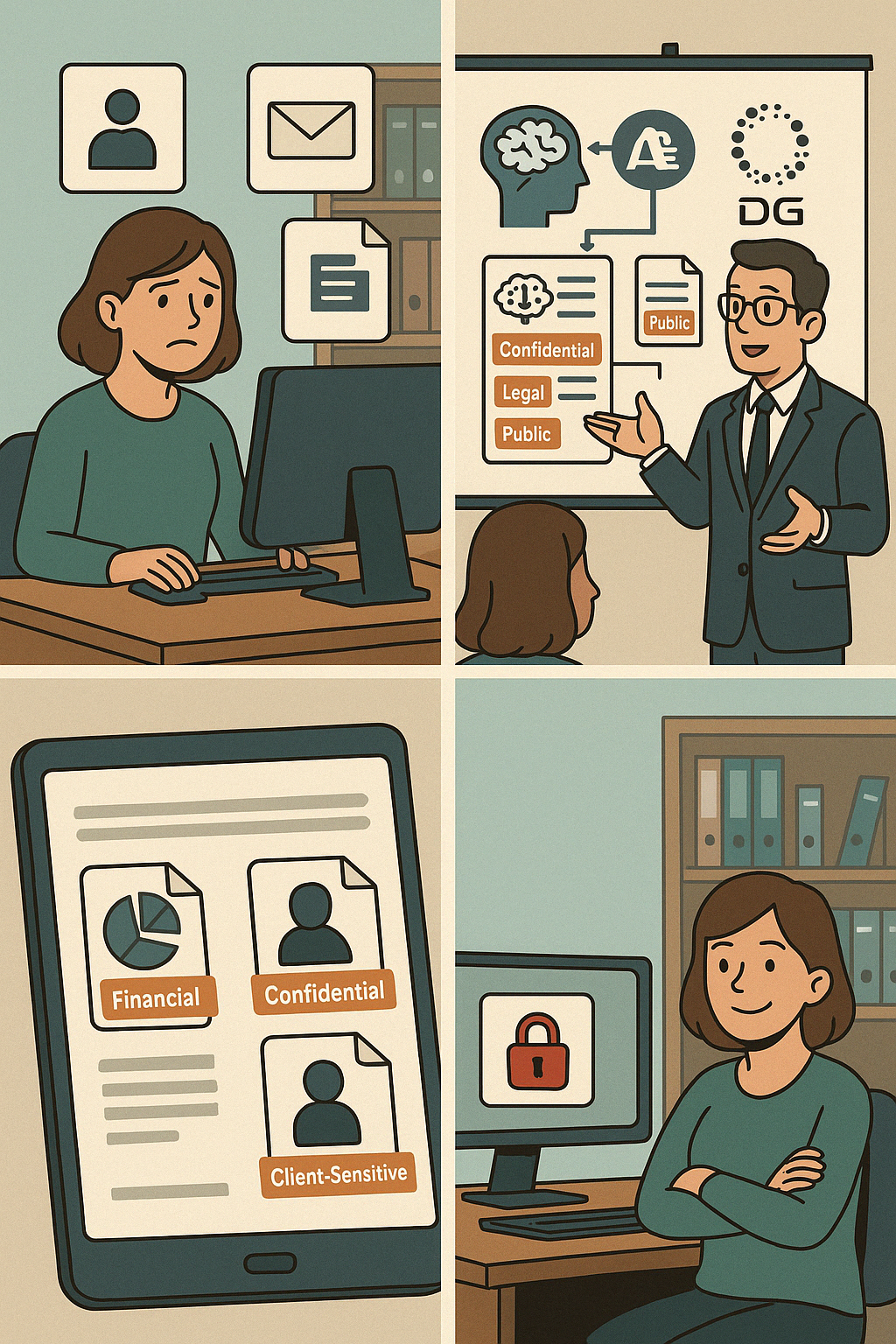
Data Gravity developed and deployed a custom AI-driven content classification system that:
-
Analyzed document content, metadata, and usage context using Natural Language Processing (NLP) techniques.
-
Leveraged machine learning algorithms trained on historical document samples to classify files into categories such as:
-
Confidential, Public, Financial, Legal, Client-Sensitive, etc.
-
-
Achieved consistent tagging based on patterns in language, file structure, and document source.
2. Metadata Tagging & Governance Enablement
-
Automatically tagged documents with classification metadata (e.g., document type, sensitivity level, source department).
-
Enabled faster search, auditable classification logs, and rule-based access control using SharePoint and Microsoft 365 tools.
-
Supported compliance teams with dashboards for monitoring classification distribution and anomalies.
3. Protection Policy Integration
-
Integrated the AI engine with Microsoft Information Protection (MIP) to dynamically apply:
-
Access controls based on role and classification
-
Encryption for sensitive content
-
Restricted sharing for confidential and financial documents
-
-
Utilized Power Automate flows to trigger actions such as alerts, archiving, or review requests based on classification outcomes.
Results
-
Achieved 93% classification accuracy on validation samples across six document categories
-
Reduced manual document handling time by 70%
-
Strengthened data governance and compliance, with automated policy enforcement across the document lifecycle
-
Freed up staff capacity, allowing teams to focus on client service, program delivery, and strategic initiatives
Client Testimonial
“With Data Gravity’s AI-based classification engine, we no longer rely on manual tagging or guesswork. Our sensitive documents are now consistently protected, and our compliance team can sleep a little easier.” IT & Compliance Manager, Not-for-Profit Organisation
Key Takeaways
-
AI-driven automation delivers scalable, accurate classification in high-volume, document-intensive environments.
-
Smart integration with Microsoft 365 tools ensures minimal disruption while maximizing security and compliance.
-
Data Gravity’s tailored approach improved operational efficiency, reduced risk, and empowered staff through intelligent automation.